Audit one product from discovery through a customer-approved order, with clear facts, safe recovery and margin-based measurement.
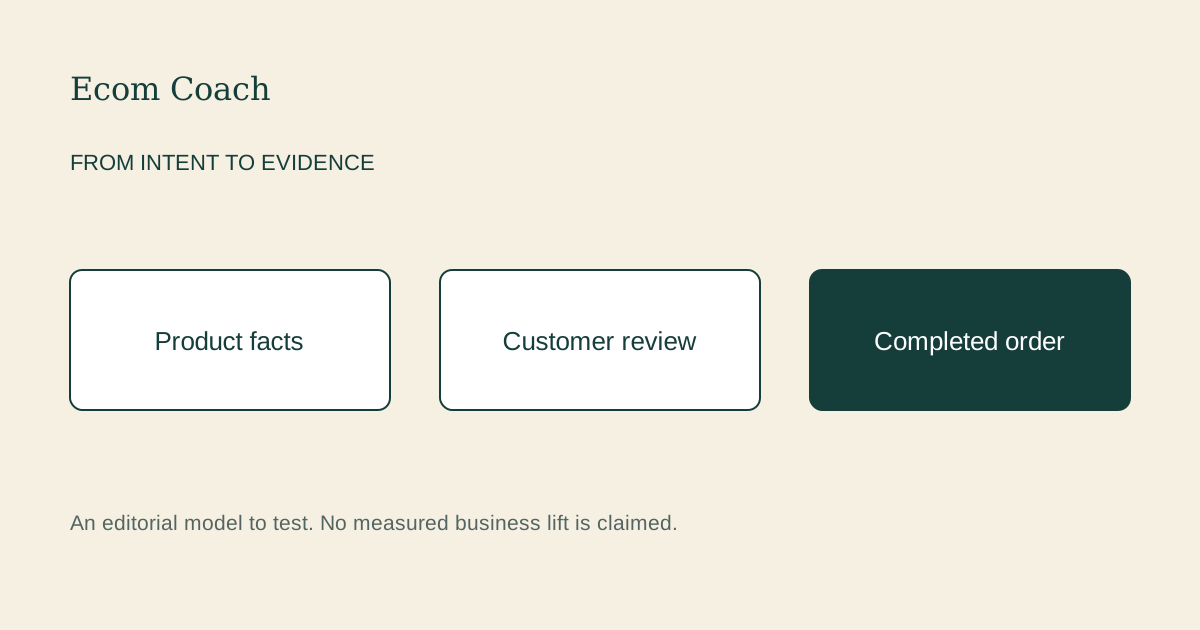
An agent can find a product, compare it and prepare a cart without being able—or authorized—to buy it. A cart created during comparison is not the same customer event as a person beginning checkout. Your measurement should preserve that distinction.
The November research brief brings together vendor observations and consumer surveys suggesting that completion and permission deserve investigation. It does not provide a universal abandonment target for your shop.
Audit one product, one destination and one task
Choose an item with repeated questions or avoidable returns. Write a realistic request with variant, quantity, destination and a constraint, such as compatibility. Record the correct answer from merchant-controlled systems before asking an assistant. Use a sandbox or stop at review; a readiness audit does not require a real charge.
| Stage | Acceptance evidence | Common failure |
|---|---|---|
| Discover | Correct product and variant IDs | A similar item is substituted |
| Understand | Fit, exclusions and return policy | Missing specification becomes a guess |
| Quote | Currency, destination, total and expiry | Shipping or tax is treated as zero when unknown |
| Review | Customer sees exact items and terms | Preparation is mistaken for payment approval |
| Complete | Order identifier and authoritative status | A timeout is mistaken for a failed order and retried twice |
Make facts agree across surfaces
The product page, merchant feed, structured data and supported API should describe the same variant and policy. State which system owns each field. Give prices and inventory freshness information. If a destination is needed for a complete quote, request it instead of producing a falsely precise total.
Start with the product-page checklist and the existing purchase-confirmation guide. Good human explanations and reliable machine-readable facts should reinforce each other.
Keep security and customer control intact
Investigate errors by cause. A 403 may reflect a valid security decision; opening every blocked route creates a different problem. Supported, authenticated integrations can receive scoped access, rate limits and logs. A claimed bot identity is not proof of authorization.
Make the handoff explicit: the agent can recommend, prepare a quote, or execute within a defined authorization. The customer should know which. Keep cancellation, price-change review and access to human help legible. A failed handoff should preserve the cart and explain the next step without exposing another customer’s data.
Measure tasks before declaring conversion gains
Record attempts, known agent identity or classification confidence, quote success, review reached, approved purchases and authoritative order status. Deduplicate retries. Separate research-only tasks from purchase-authorized tasks. Otherwise a wave of comparison queries can make an unchanged checkout appear worse.
Primary operating measure: correctly completed eligible purchase tasks divided by eligible purchase tasks. Pair it with unauthorized-action count, duplicate orders, corrections, refunds, support minutes and contribution margin. Track ordinary customer outcomes too, so an agent-friendly change does not harm people.
Run a bounded repair
Fix one verified bottleneck for one product family. Test stale stock, an expired quote, an unavailable variant and a lost response as well as the happy path. Use enough repeated tasks to expose inconsistency; record the actual count and model/integration version rather than claiming that a small demo proves reliability.
If real traffic supports a controlled experiment, compare qualified completion and retained margin. If it does not, describe the result as an operational acceptance test. The first useful win is knowing exactly where the journey fails and who can repair it.
Continue with the companion guides
- AI shopping, experiment bias, and the difference between retention and loyalty
- The web after AI agents: build for decisions and completed work
- UX for AI agents: design APIs that deliver a result people can trust
Published November 7, 2026. Recommendations and scenarios are editorial proposals, not measured portfolio or client outcomes.