Use the weekend to improve clarity, stock allocation and follow-up, then carry the relationship into December without exhausting customers or margins.
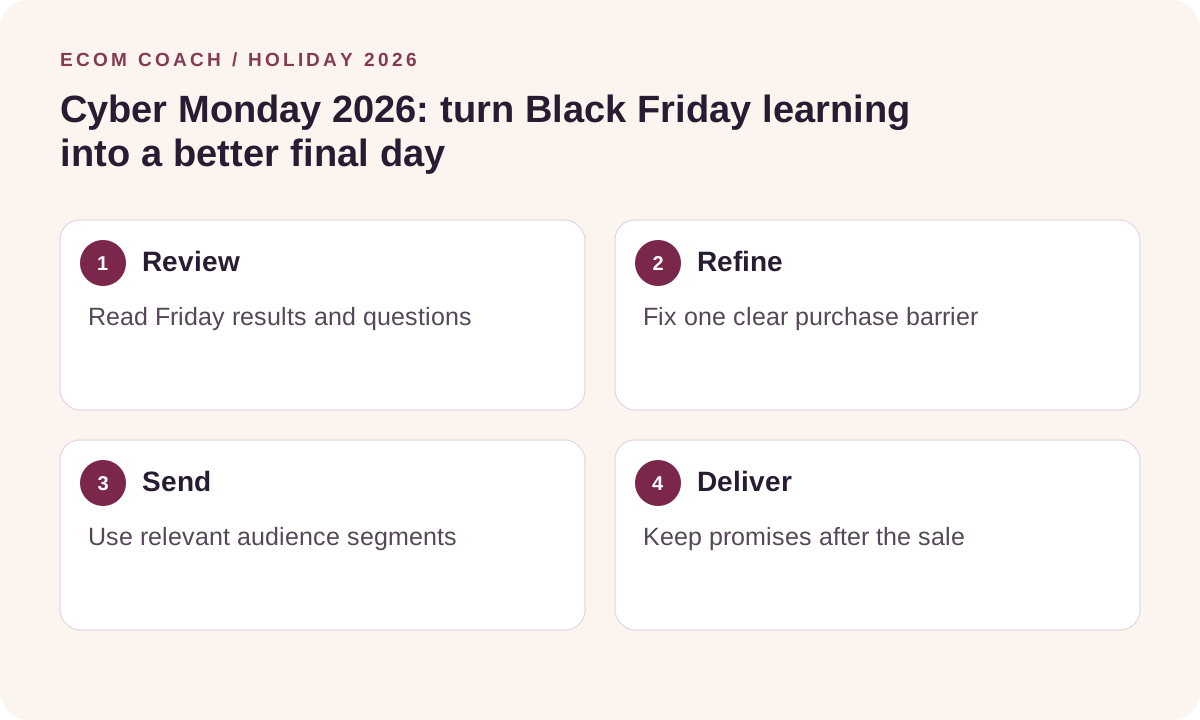
Holiday 2026 field guide. Start with the holiday growth center. Black Friday: November 27. Cyber Monday: November 30. Examples below are planning scenarios, not client results.
Cyber Monday is November 30, 2026
Black Friday falls on November 27. Use the weekend between them to check what customers actually did. Cyber Monday does not need a bigger discount by default. It needs a relevant offer, available stock, a working checkout and clear communication.
Dates follow the 2026 retail calendar. The schedule below is a suggested operating plan, not a promised result or a required sending cadence.
Friday night and Saturday: review the evidence
- Reconcile sales, orders, spend and variable costs in the scorecard.
- Read customer questions and payment/checkout failures.
- Compare stock remaining with pending orders and realistic fulfillment capacity.
- Inspect promotion rules: which items sold, which discount combinations reduced contribution and which delivery promises need clarification?
Do not call a creative or page the winner solely because it had more sales on a busier day. Record traffic, sample size and audience differences. Fix obvious defects immediately; treat performance explanations as hypotheses.
Sunday: prepare a simpler decision
Build a concise page featuring the items you can still deliver well. Replace unavailable recommendations and correct stale prices. If stock is genuinely limited, explain the facts without invented urgency. Show a clear promotion end time and time zone, and make that time agree with checkout rules.
| Audience | Useful message | Exclusion or check |
|---|---|---|
| Recent purchasers | Order reassurance, care information or a genuinely relevant accessory later. | Suppress the same acquisition offer; avoid making recent buyers feel misled. |
| Engaged subscribers who have not purchased | A simple offer, useful comparison and delivery answer. | Respect consent, suppression and recent send frequency. |
| Eligible cart/checkout abandoners | A reminder that addresses a known hesitation. | Stop the flow after purchase; do not stack conflicting discounts. |
| High-value prospects | Answer the open question or provide the requested quote/demo. | Do not pressure people with unverified delivery or financing claims. |
Monday: operate the promotion calmly
Before launch, test the actual link, price, mobile basket, shipping options and payment method. Assign an owner for the site, campaign and operations queue. Agree on review times. If checkout breaks or a product cannot be fulfilled, pause the affected promotion and correct the cause.
A practical campaign might include a morning message and one final reminder only to an appropriate engaged, non-purchasing audience. It is not a universal prescription. Use your audience’s response and frequency history. Additional sends are not free if they create complaints or unsubscribe the customers you want to keep.
End the offer when you said it would end. If you genuinely extend it, explain the change transparently rather than pretending the original deadline still applies.
December: the sale becomes a customer relationship
- First days: send accurate transactional confirmations and shipping updates; separate marketing from essential order messages.
- Before your store’s verified cutoff: make shipping deadlines and processing time visible. Do not copy a generic carrier date as your promise.
- After the cutoff: offer local pickup, digital gifts or gift cards only where the systems and policies support them. Say what remains possible.
- After delivery: provide care/setup help, then request honest feedback at an appropriate time.
- After returns mature: review contribution and the second-purchase cohort before deciding what to repeat next year.
A useful end-of-season review
Record the offer, audience, channel, sales, contribution, fulfillment delays, return reasons and customer feedback. Pick one process to keep, one to repair and one to stop. “Our biggest revenue day” is incomplete if the store spent the following month correcting avoidable problems. A successful season should leave you with healthier economics and a stronger next purchase path.
Download the free holiday action workbook or calculate your daily scorecard.
Lifecycle Revenue Sprint · From $1,500
Build or repair one agreed email flow in your existing platform, with up to three emails and trigger QA.
Start with a free fit conversation. A written scope and payment instructions come before paid work begins.