A practical learning project for PPC, keyword research, product pages, measurement, and retention—built around one product and its real order economics.
What should you learn first in ecommerce marketing?
Start with one product, one customer need, and the amount an order can contribute before advertising. Then study how a shopper discovers the product, evaluates it, buys it, and decides whether to return. This connects PPC, keyword research, conversion design, and lifecycle marketing in one manageable project.
You can complete the first version without buying traffic. A spreadsheet, a draft product page, a set of ad concepts, and a measurement plan are enough to practice the decisions. Running a live campaign adds real evidence, but spending money is not a prerequisite for learning the foundations.
Build the economics before the campaign
Choose a product with understandable costs and a clear use case. Record selling price after discounts, product cost, payment fees, fulfillment, shipping subsidy, and a reasonable returns allowance. Keep tax collected for remittance separate from sales revenue when defining your calculation.
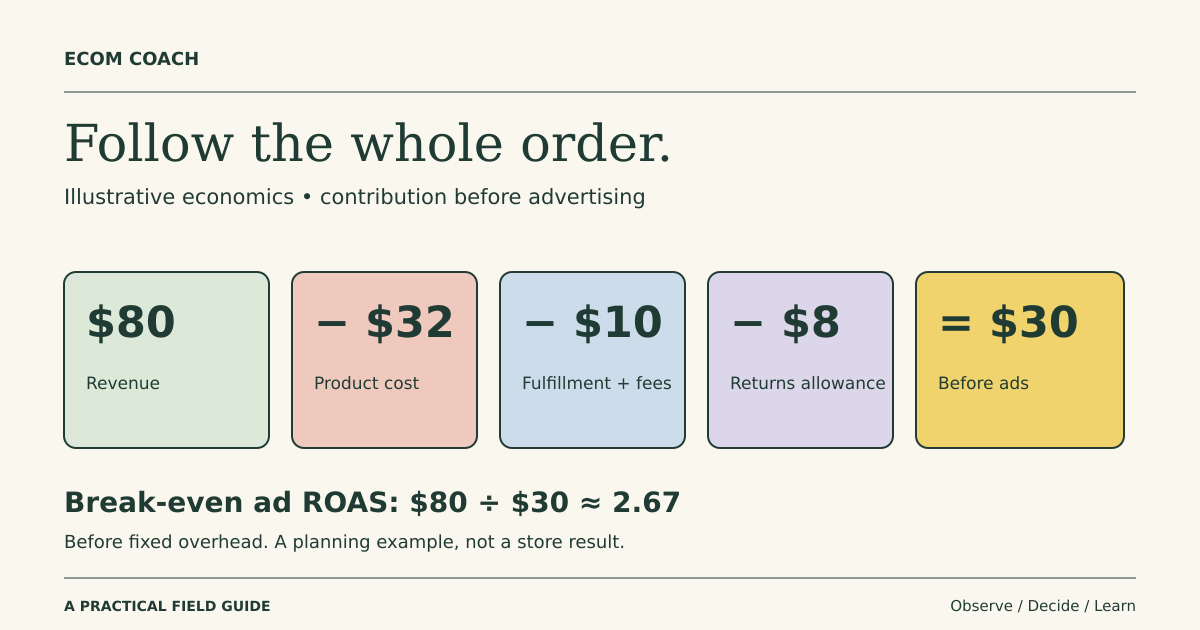
Illustrative example, not a store result: an $80 order has $32 in product cost, $10 in fulfillment and payment costs, and an $8 allowance for returns and related costs. That leaves $30 before advertising and fixed overhead. Spending $30 to acquire that order would use the entire contribution; it would not create $30 in profit.
The corresponding first-order advertising break-even ROAS is $80 ÷ $30, approximately 2.67. This simplified threshold excludes fixed overhead and assumes the cost estimates hold. A sustainable operating target may need to be higher. Do not justify a loss using repeat purchases that have not been observed.
Turn keyword research into a shopping-intent map
Imagine a store selling washable travel organizers. A person searching “how to pack toiletries” may want advice. “Best washable toiletry bag” suggests comparison. “Buy washable toiletry bag with compartments” is closer to a transaction. These are sample phrases, not verified search-volume estimates.
Create four columns: search phrase, likely question, useful destination, and reason to exclude or investigate. A guide can answer an informational question; a comparison needs specific tradeoffs; a product page needs price, dimensions, delivery, and evidence that the product fits the job.
Use Google Keyword Planner to investigate ideas and estimates. Treat forecasts as planning inputs, not promised traffic or sales. After launch, review the actual available search terms alongside conversions and costs. Your chosen keyword and a shopper's actual search are different pieces of information.
Build a promise the product page can keep
Write three genuinely different ad concepts: the customer problem, a useful product capability, and an occasion or use case. Each concept needs evidence. A washable material is a product fact only if it is verified; a claim such as “never leaks” needs more than attractive copy.
On the landing page, answer the objections the ad creates. Explain size and fit, care, shipping, returns, and what is included. Show the product in context. Review mobile readability, variant selection, error messages, and the route back from checkout. A higher click-through rate is not useful if it attracts people the offer cannot serve.
Use the advertising learning path for channel-specific skills, then apply the keyword and intent guide to your chosen product. This project is the place to connect those lessons.
Define what each measurement means
Write an event plan before spending. Distinguish a product view, add to cart, checkout start, and completed purchase. Identify which event is the campaign's intended business outcome. Document how revenue, currency, duplicate orders, cancellations, and refunds will be handled by the tools you use.
When testing tracking, use a permitted test order and confirm it appears once in the appropriate systems. Compare the store's order records with analytics and advertising reports; consent, attribution windows, and reporting delays can produce differences. Neither a dashboard total nor an ad platform's attributed revenue is automatically incremental revenue caused by advertising.
Extend the project beyond the first sale
Draft the first useful post-purchase message: care instructions, setup help, or what happens next. Choose a retention signal that fits the product. Repeat purchase may matter for consumables; successful use and relevant referrals may be more realistic for a durable item.
Keep service messages and promotional consent requirements clear. Do not send repetitive reminders after a customer has completed the action. Measure returns, complaints, contribution, and customer quality as well as order count. Read the campaign planning guide before creating a long email sequence.
Your four-week practice project
| Week | Work to produce | Question to answer |
|---|---|---|
| 1 | Order-economics sheet and customer problem | What can one order support? |
| 2 | Intent map, exclusions, and page outline | Does the destination answer the search? |
| 3 | Three ad concepts and an event plan | What will the campaign promise and measure? |
| 4 | Campaign review and post-purchase flow | What should change, and what evidence supports it? |
If you run a live test, agree a spending ceiling and review conditions first. Small samples can expose obvious problems, but a handful of purchases cannot establish a reliable winning campaign. Record uncertainty instead of turning every fluctuation into an optimization.
Questions store owners ask
Should I learn every advertising platform at once?
Choose one channel that fits your customer's buying behavior and your creative capacity. Learn its measurement and operating decisions deeply before multiplying campaigns. Keep organic discovery, the product page, and retention in the same business picture.
Is ROAS the main measure of success?
It is one useful revenue-to-ad-spend ratio. It does not include all costs, customer quality, or the counterfactual of what would have happened without the campaign. Pair it with contribution and the store's actual orders.
What belongs in a beginner portfolio?
Include the brief, economics, intent map, ad rationale, page decisions, event plan, and a candid review. Label simulated data and draft campaigns. If no campaign ran, show your reasoning without inventing results.
Ecommerce Growth Coaching · $750 / month
Two working sessions per month on one growth priority, with written next steps and one agreed artifact review.
Start with a free fit conversation. A written scope and payment instructions come before paid work begins.