Use relevant bundles, transparent shipping thresholds and optional add-ons to increase basket value while protecting contribution and customer trust.
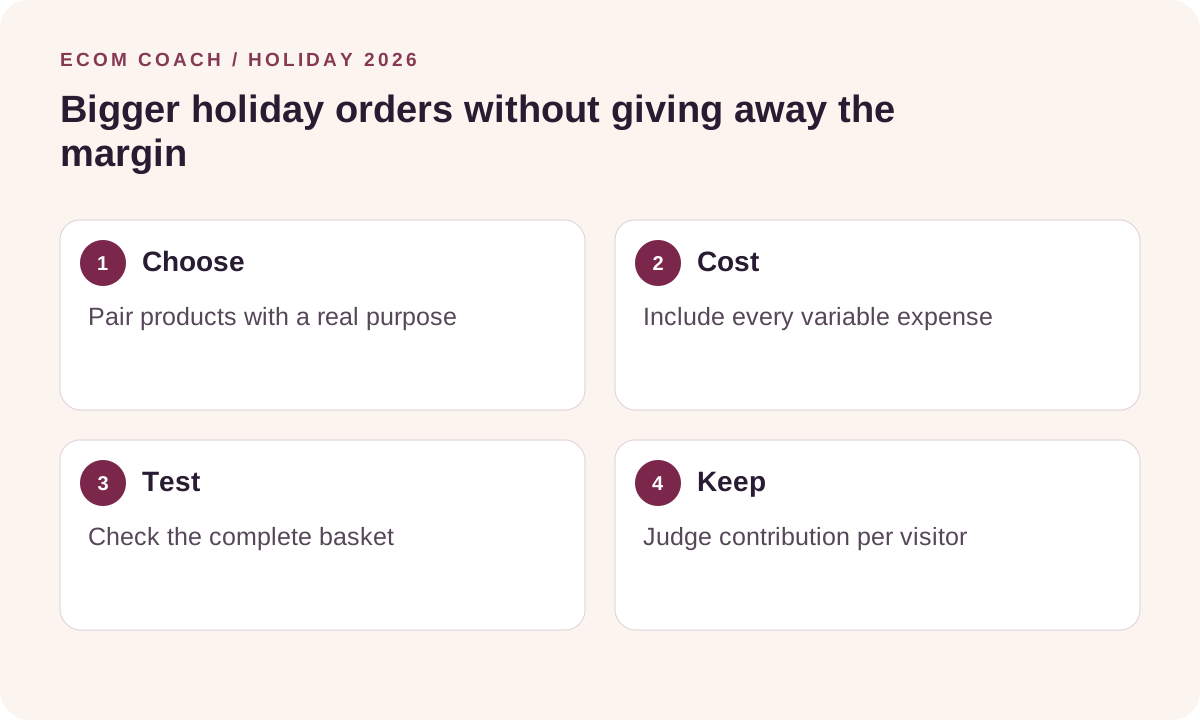
Holiday 2026 field guide. Start with the holiday growth center. Black Friday: November 27. Cyber Monday: November 30. Examples below are planning scenarios, not client results.
A bigger basket is useful only if the economics improve
Do not optimize AOV on its own. A large discounted order can leave less money than a smaller full-price purchase. Compare contribution per order and contribution per visitor, then watch returns. The right offer also helps the customer choose something they need.
Five offers worth evaluating
| Offer | Example | Check before launch |
|---|---|---|
| Complete-the-task bundle | Coffee grinder + compatible beans + cleaning brush. | Compatibility, variant availability, actual combined cost and return handling. |
| Good / better / best | Single candle / candle pair / candle plus a matching holder. | Make differences explicit; every tier should be a sensible purchase. |
| Useful free-shipping threshold | A threshold a typical shopper can reach with one relevant add-on. | Incremental margin must cover the shipping subsidy and extra fulfillment. |
| Optional gift service | Wrapping and a message at a clear price. | Labor time, materials, order cutoff and capacity. |
| Volume or corporate gifting | A priced quote for an office team’s gift order. | Lead time, personalization, delivery locations, payment terms and stock. |
Step 1: pick complementary products
Use purchase history, search behavior and customer questions to find items that naturally belong together. Keep the first bundle simple. Photograph the actual contents, name every included item and show sizes. Do not use a bundle to hide an unsuitable product or move stock that will create disappointment.
Step 2: model the contribution
Illustrative example: a $60 item has $24 product cost and $9 other variable costs, leaving $27 before acquisition. A useful $20 add-on costs $7 and adds $2 of fees/handling. The combined $80 basket leaves $38 before acquisition. If the bundle is discounted to $72, contribution becomes $30, assuming the stated costs. That is $3 more than the original order, not $12 more simply because AOV rose by $12.
If conversion falls enough, the bundle may still lose. With 1,000 visitors, 20 single orders at $27 contribution produce $540 before acquisition; 17 bundles at $30 produce $510. These figures are illustrative, not target conversion rates. Use the promotion calculator for comparable baskets.
Step 3: test shipping and discount interactions
A shopper increasing a basket from $70 to $90 creates $20 extra merchandise revenue. At an assumed 50% incremental product margin that is $10 before added costs. An $8 shipping subsidy and $3 extra handling/fees would consume $11, making the threshold worse by $1. Use your costs and test multiple destinations; shipping is not one flat number for every basket.
- Add the base product, then the bundle or add-on.
- Try every valid discount combination and a code that should fail.
- Check whether gift cards, sale items and subscriptions count toward thresholds.
- Remove one item; confirm the price and benefit recalculate correctly.
- Test an out-of-stock component and a partial return using the platform’s supported process.
Step 4: keep the experience easy
Offer one relevant add-on near the cart. Make it optional, show the full added price, and make removal straightforward. Avoid preselected extras and repeated pop-ups. Explain genuine promotion end times; do not reset a countdown to create artificial urgency.
For low-volume stores, combine basket data with direct feedback. A seasonal before/after comparison cannot prove causation. Keep a change only when evidence supports it and contribution, return rate and fulfillment workload remain acceptable. See the premium purchase guide for expensive items that need a different path.
Download the free holiday action workbook or calculate your daily scorecard.
Store Growth Review · $750
Review one shopping journey, up to five pages, and leave with prioritized findings and a two-week action plan.
Start with a free fit conversation. A written scope and payment instructions come before paid work begins.